Act 20 is a law that was passed in the State of Wisconsin to improve reading skills for young students.
The goal is to ensure that all students are reading proficiently by the end of third grade, setting a strong foundation for their future academic success. Hamilton School District is committed to our mission of ensuring maximum achievement for each student.
Components of Act 20
“Science-based” reading instruction
Science-based early reading instruction is defined as systematic and explicit instruction in at least all the following areas: phonological awareness, phonemic awareness, phonics, background knowledge, oral language development, instruction in writing, instruction in comprehension, vocabulary building, and reading fluency.
Definitions of related terms
Phonological awareness
the awareness of all levels of the speech sound system (syllables, beginning sounds, ending sounds, middle sounds, etc.)
Phonemic awareness
the awareness of speech sounds in words and the ability to consciously manipulate those sounds
Phonics
the relationship between sounds and letters
Background Knowledge
preexisting knowledge of facts and ideas related to a topic or concept
Oral Language Development
Refers to developing a system of words and word combinations to communicate with others through speaking and listening
Comprehension
making meaning of what is viewed, read, or heard. Comprehension includes understanding what is expressed outright or implied as well as interpreting what is viewed, read, or heard by drawing on one’s knowledge and experiences.
Vocabulary Building
Refers to instruction of expressive (words said & produced) and receptive vocabulary (words heard & understood) with the purpose of expanding students’ knowledge of words and their meanings
Reading Fluency
the ability to read with accuracy, speed, and proper expression
Decoding Skills
the ability to break down words into their individual sounds and then blend those sounds together to read and understand the words. It’s the process of translating written symbols (letters) into spoken language. Decoding skills are essential for fluent reading and are often one of the early skills developed when learning to read
Alphabet Knowledge
knowing the names of all the uppercase and lowercase letters
Dyslexia
Wisconsin’s Informational Guidebook on Dyslexia
An informational guidebook discussing screening, instruction, intervention & resources
Screening and assessments
Act 20 mandates regular screening and assessment of students in kindergarten through third grade to identify those who are struggling with reading early on.
All students in 4K-3rd grade will be required to take the aimbswebPlus early literacy screener 3 times a year and all students in 4K will be required to do so twice a year.
All students who score below the 25th percentile on the screener will be required to complete diagnostic testing within 10 days of receiving the screener results.
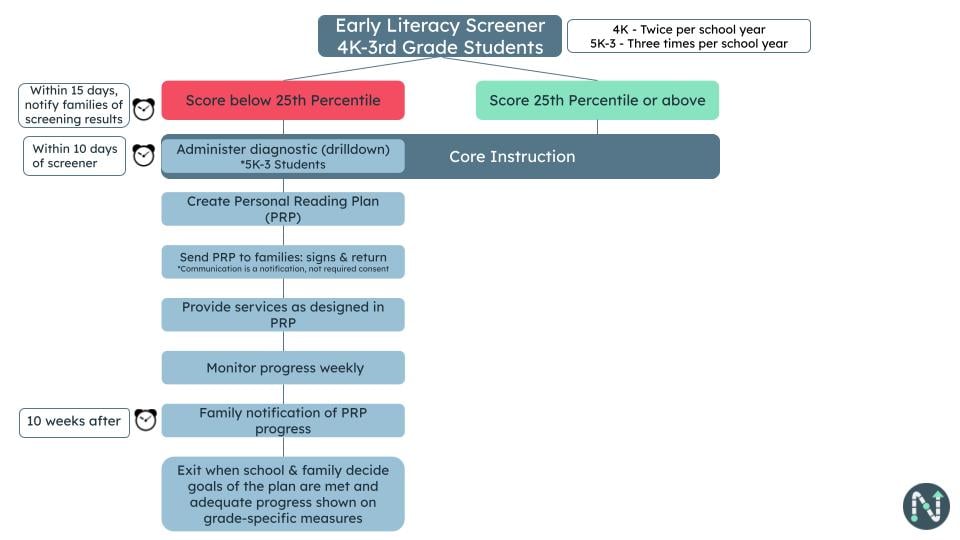
In the assessment process, it may be determined through diagnostic testing that the original screener was not accurate for the student. As a result, the student’s Personal Reading Plan will include reading progress monitoring data.
Family communication
Schools will provide results of the reading assessments to the parents no later than 15 days after the reading readiness assessment is scored.
If the student has a personal reading plan, parents must be notified every 10 weeks of the student’s progress.
Personal reading plans
All students who score below the 25th percentile on the screener will be required to have a Personal Reading Plan. Hamilton School District will create a personal reading plan for all qualifying students. This plan will be created in NextPath and include all required information. All plans will be shared with families.
Curriculum
Wisconsin public schools, independent charter schools, and schools participating in the Choice program are required to implement K-3 literacy instruction that aligns with the statutory definition of science-based early literacy instruction. Science-based early reading instruction is defined as systematic and explicit instruction in at least all of the following areas: phonological awareness, phonemic awareness, phonics, background knowledge, oral language development, instruction in writing, instruction in comprehension, vocabulary building, reading fluency. Act 20 does not require schools to change their curriculum. It does require schools to implement science-based early literacy instruction as defined in the statute and prohibits schools from implementing three-cueing instruction as defined in the statute.
In the Hamilton School District, teachers use the Heggerty Bridge to Reading program for daily instruction in phonemic awareness, phonics, reading fluency, and word morphology. In addition, we have our K-2 Humanities curriculum that has been written by teachers and literacy specialists in our district. This curriculum includes priority standards, high-quality mentor texts, and variety of instructional strategies in order to meaningfully teach and integrate literacy and social studies content.
View Hamilton School District’s Early Literacy Support Process
Teacher training
Act 20 requires all K-3 teachers, principals where there are grades K-3, and reading specialists receive training on science-based literacy instruction. This must be from an approved list.
All K-4 teachers, Special Education teachers, and EL teachers are trained in accredited science-based early reading instruction.